
Issue, No.39 (September 2026)
Luxembourg Consumption Study (LCS) Database – Beta Launch
1. Introduction
After four decades of harmonising income microdata through the Luxembourg Income Study (LIS) and two decades of harmonising wealth microdata through the Luxembourg Wealth Study (LWS), LIS is now establishing a third pillar of its data infrastructure: the Luxembourg Consumption Study (LCS). This initiative responds to a long-standing gap in comparative household research and is grounded in the Stiglitz–Sen–Fitoussi Commission Report of 2009, which identified income, consumption, and wealth as three core, complementary dimensions of household economic well-being.
Over the past several decades, cross-national research on household living standards has relied predominantly on income as a proxy for welfare (e.g., Atkinson et al. (1995) and Smeeding et al. (1990)). Yet income captures only one dimension of a household’s economic position. Consumption is argued by many scholars to be a more direct and stable measure of material well-being, particularly at the lower end of the distribution. The Luxembourg Consumption Study (LCS) addresses this gap directly, aiming to produce a harmonised, cross-national micro-database of household consumption. It draws on household budget survey data from countries at all income levels, using a consistent framework broadly aligned with the international Classification of Individual Consumption According to Purpose (COICOP) 2018, while accounting for both monetary and non-monetary components of consumption.
The ICW Framework and LCS Positioning
The concept of joint income–consumption–wealth (ICW) measurement provides the overarching intellectual framework within which the LCS is positioned. Prompted by the Stiglitz–Sen–Fitoussi Report, two major expert groups have shaped the methodological agenda: the OECD Expert Group on the Joint Distribution of Income, Consumption, and Wealth (EG ICW) and the OECD–Eurostat Expert Group on Disparities in National Accounts (EG DNA). These groups have worked to develop guidelines and experimental results for measuring household well-being in a coherent, multi-dimensional manner.
LIS extends this agenda at the micro level. Whereas the ICW framework as developed by the OECD focuses primarily on linking macro-level national accounts data with micro distributional information, the LCS provides a fully harmonised micro-database enabling direct household-level analysis. The LCS complements LIS and LWS by adding the missing consumption dimension, enabling researchers to study the joint distribution of income, consumption, and wealth for the first time in a harmonised cross-national setting, even though the three dimensions are in most countries not currently observed on the same households.
2. Research Motivation and Conceptual Background
The case for a harmonised consumption database rests on multiple complementary arguments. First, consumption provides a more direct measure of current living standards than income, particularly in contexts where income is volatile, underreported, or smoothed through savings and borrowing. Consumption expenditure is less sensitive to transitory income shocks and tends to track permanent income more closely. Second, in many lower-income countries, household budget surveys recording consumption are the primary instrument for measuring household welfare. Excluding these countries from comparative welfare databases creates a serious blind spot. Third, a rapidly expanding research agenda on inflation inequality, carbon footprints, distributional effects of indirect taxation, and energy poverty requires consumption microdata at the level of detail that LCS provides.
The literature has long recognised the limitations of relying exclusively on income for welfare analysis. Deaton and Zaidi (2002), Mancini and Vecchi (2022), and Garner et al. (2025) have laid out the methodological foundations for constructing comparable consumption aggregates across countries. The LCS draws directly on this body of work, operationalising its insights into a practical harmonisation framework.
Consumption vs. Expenditure vs. Welfare
A central distinction runs through the LCS framework: expenditure, consumption, and welfare are related, but not interchangeable.
Expenditure refers to households’ monetary spending on goods and services — the most readily available survey measure, but broader than consumption: it also includes purchases given away as gifts or donations.
Consumption expenditure narrows this down to spending on goods and services intended for the direct satisfaction of the household’s own needs or wants (SNA 2025), but still misses non-monetary items such as own production, in-kind transfers, and in-kind pay or benefits.
Consumption itself is the flow of goods and services actually available to and used by the household: purchases, home production (notably food and owner-occupied housing), in-kind receipts from employers, the state, or other households, and ideally the service flow from durables rather than their purchase price. Durables bought at one point but used for years otherwise distort the timing of consumption; health and education spending, meanwhile, often reflects public provision more than welfare, and remain the most debated items in consumption-based measures.
Welfare is the broader concept, which consumption only partly approximates. The LCS Expert Workshop (January 2026) stressed that no single indicator fully captures welfare. Consumption serves poverty analysis well but is less suited to measuring top-end inequality.
The LCS therefore adopts a modular approach: rather than one definitive measure, it offers clearly labelled building blocks from which users can construct the aggregate best suited to their research.
3. The LCS Project: From Feasibility Studies to Beta Launch
The LCS has followed a staged, evidence-based path spanning several years, each phase feeding into the methodological design and operational framework reflected in the September 2026 beta-launch variable list.
Feasibility Studies
Two feasibility studies have shaped the LCS framework:
- Mancini and Vecchi (2023) confirmed the viability of a comparable consumption micro-database, proposed a cross-country consumption aggregate, built an LCS-specific harmonisation template, and piloted it across four countries. A key finding: excluding durable flows mattered less than expected, but imputed rent proved critical for cross-country comparability.
- Garner et al. (2025) extended the analysis to nine countries spanning low- to high-income contexts (Mali, Laos, Palestine, Peru, Georgia, Italy, France, the United Kingdom, and the United States). It established COICOP 2018 as the LCS’s structural backbone, refined the consumption aggregate, documented equivalence-scale sensitivity, and confirmed housing and imputed rent as central to cross-country comparability, reinforcing a flexible design over a single rigid measure.
Both studies are published as LIS Working Papers and are publicly available: Mancini and Vecchi (2023) and Garner et al. (2025), and directly inform the variable list, schema, and harmonisation choices described here.
Expert Workshop, January 2026
A two-day LCS Expert Workshop (14–15 January 2026, Belval) brought together scholars and institutional partners, including the OECD and the World Bank, to review the LCS’s methodological priorities and research agenda. Its key conclusions are summarised below.
- Emerging Consensus
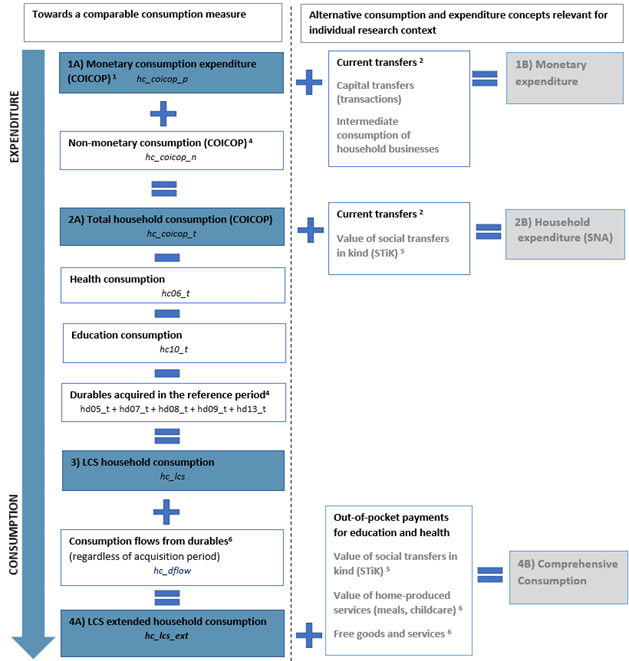
No single aggregate suits every purpose: the LCS provides components so users can build the aggregate that fits their question. Modularity is the guiding principle: a core aggregate plus clearly flagged extensions for imputed rent, durable flows, health and education, and social transfers in kind (STiK), which cannot simply be excluded without biasing welfare-state comparisons. Different research purposes, ranging from poverty analysis, inequality measurement, environmental research, fiscal incidence call for different lenses and different aggregate definitions, so comparability should be operational rather than doctrinal: respecting national survey practices while documenting differences serves research better than forcing standardisation. - Health and Education
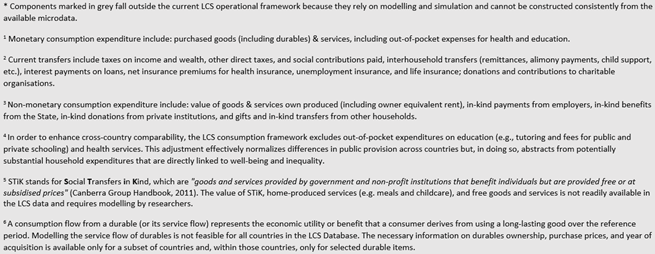
Health and education were the most debated components. Out-of-pocket health and education expenses are excluded from the core LCS well-being measure. Health because it is often an involuntary response to illness with poor cross-country comparability, education for similar reasons tied to differing public provision. Both remain available as separate variables and are included in the COICOP expenditure aggregate. Health insurance contributions are excluded from both, since private and social insurance could not be consistently distinguished across surveys, and are reported instead among non-consumption expenditure. - Durables and Service Flows
Durables expenses are recorded in the COICOP aggregate but excluded from the core LCS well-being measure, since a full inclusion overstates consumption in the purchase year and understates it afterwards. Where national providers can supply service-flow estimates instead, these would feed a separate module and an extended consumption aggregate, though none currently provide this information, so this section remains unpopulated for now. A non-core file on durable goods ownership is nonetheless being built, so this can be modelled as more data become available, and will be released shortly. - Imputed Rent – flow of services from shelter
Imputed rent — the flow of housing services from shelter — was flagged as a high-priority investment: its absence, notably in Poland, Switzerland and the United Kingdom, is a major limitation for cross-country comparability, especially between tenure types. It is typically valued through rental-equivalence, whether from self-assessment, hedonic modelling, or administrative valuation, though all these methods depend on a comparable local rental market. Where owner-occupied imputed rent is missing, the LCS does not build the upper-level aggregates that require it. - Deflation
The workshop prioritised temporal deflation for over-time comparisons. LIS has already mapped annual World Bank price indices for this purpose. Further investigations about detailed information for consumption items are underway. Spatial deflation was seen as valuable but more context-dependent, since local price differences can reflect amenities as much as costs.
Figure 1 sets out the resulting conceptual schema: the current state of consumption expenditure measurement and the paths toward a fully comprehensive consumption concept. It is advised to consult the technical LCS documentation for further detail.
Figure 1. The LCS Conceptual Schema
4. What the Data Show
Table 1 illustrates the consumption mix across 13 of the 16 beta-release countries. Poland, Switzerland, and the United Kingdom are excluded from this table: imputed rent is an important component of housing consumption, and without a reliable estimate for it, these countries’ consumption mix would generally understate housing in the LCS well-being measure. For the remaining 13 countries it is a clean illustration of Engel’s law at work: as income rises, the food and non-alcoholic beverages share falls from 65.7% in Mali to 24.6% in Mexico, 17.9% in Spain, and just 11.2% in Luxembourg. Housing moves in the opposite direction, from 11% of the budget in Mali to over 35% across most high-income countries and 42.3% in Luxembourg, becoming the largest single spending category well before the top of the income range.
Table 1. Consumption Mix – LCS Well-Being Measure
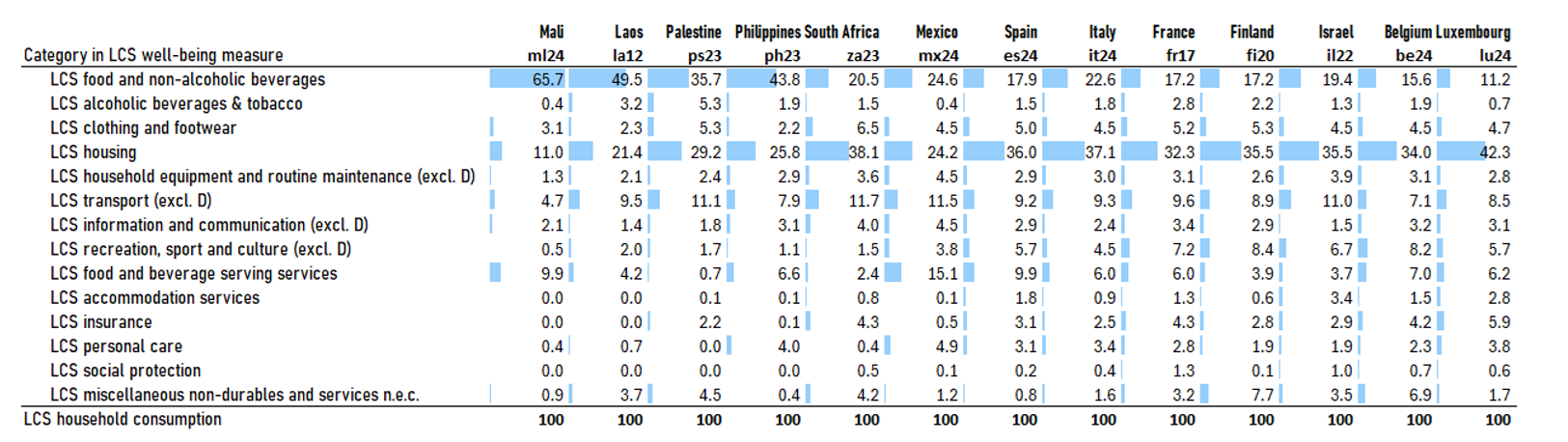
Note: Countries are ordered by World Bank income classification, from low income (Mali) to high income (Luxembourg). LCS Well-being measure excludes durable expenses and out of pocket expenses for health and education in the reference period.
Source: Luxembourg Consumption Study (LCS) Database.
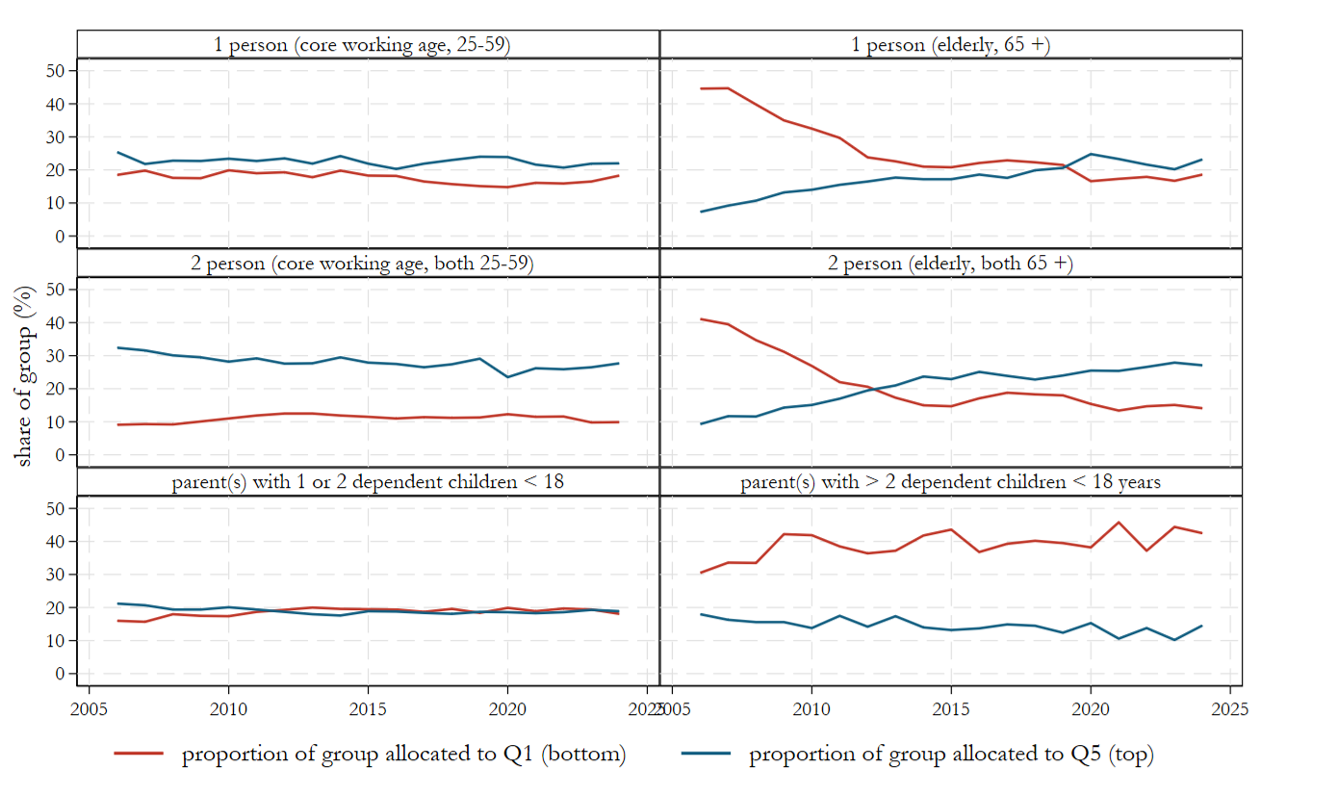
Focusing on the time dimension, in Spain, the data reveal a striking generational shift. Single elderly households (65+) were once heavily concentrated at the bottom of the consumption distribution, with 45% in the bottom consumption quintile in 2006 (Figure 2). By 2020, that share had fallen to 16.6%, while their presence in the top quintile roughly tripled, from 7% to nearly 25%. Couple retire households show a similar pattern. Since 2021 the patterns remained stable for all population groups. It is this kind of within-group change over time that a harmonised consumption series, rather than a single cross-section, can capture.
Figure 2. Household Types Allocated to Bottom and Top Consumption Quintile – Spain
Source: Luxembourg Consumption Study (LCS) Database.
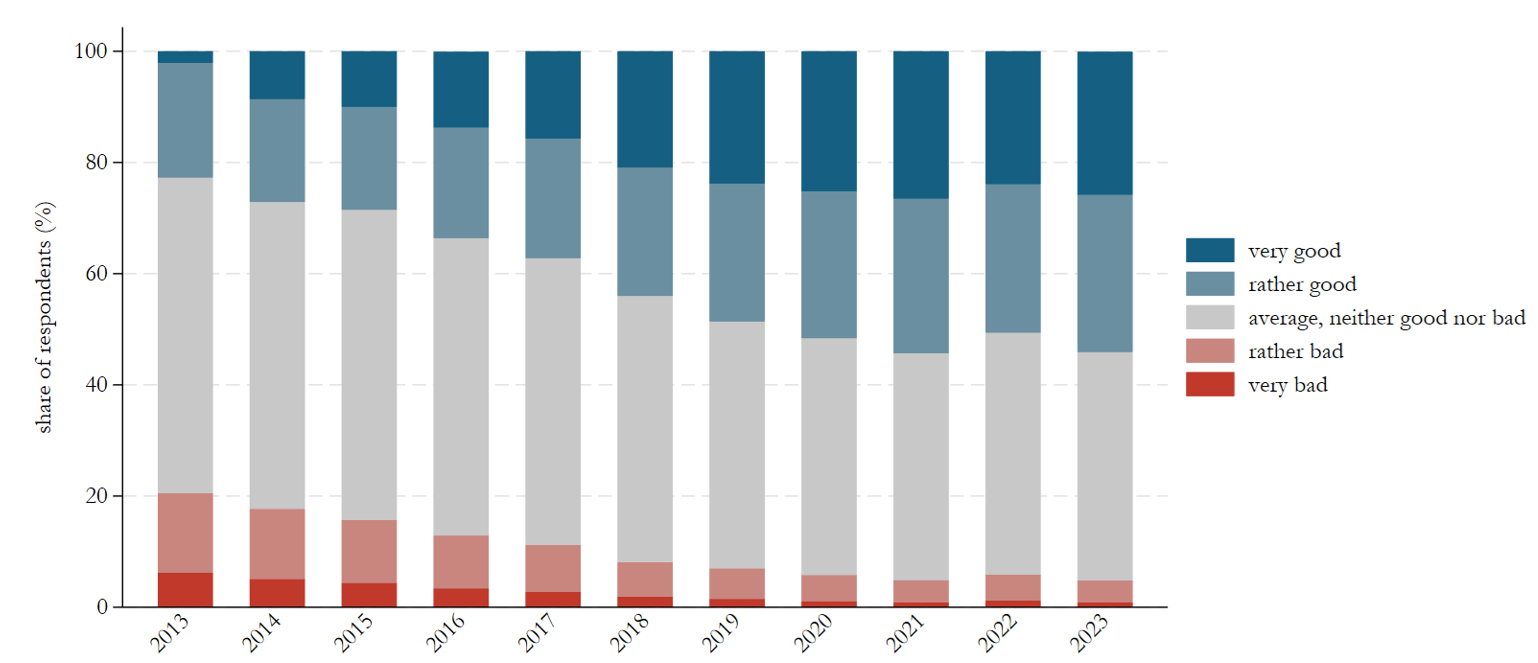
Another interesting case for over-time trends is identifiable in Poland. Polish household’s, self-reported financial satisfaction has improved markedly over the period from 2013 to 2023 (Figure 3): the share of households rating their ability to make ends meet as “very good” rose from 2% in 2013 to 26% in 2023, while those rating it “very bad” fell from 6% to under 1%. Alongside the expenditure data, this subjective measure adds a welfare dimension that spending figures alone would not show.
We look forward to your analyses with the LCS data!
Figure 3. Assessment of Households’ Financial Situation – Poland
Source: Luxembourg Consumption Study (LCS) Database.
References
| Atkinson, A.B., Rainwater, L., and Smeeding, T.M. (1995). Income Distribution in OECD Countries: The Evidence from the Luxembourg Income Study. Paris: OECD. |
| Balestra, C. and Oehler, F. (2023). Measuring the Joint Distribution of Household Income, Consumption and Wealth at the Micro Level. OECD Papers on Well-Being and Inequalities, Working Paper No. 11. |
| Deaton, A. and Zaidi, S. (2002). Guidelines for Constructing Consumption Aggregates for Welfare Analysis. LSMS Working Paper No. 135. World Bank. |
| Garner, T.I., Lanjouw, P.F., Matsumoto, B., Mazeikaite, G., Munzi, T., Neugschwender, J., Omar, H., and Schild, J. (2025). Building a Comparable Measure of Consumption: Concepts and Measurement Challenges Faced by Emerging and Advanced Economies. LIS Working Papers Series, No. 912, LIS Cross-National Data Center in Luxembourg. |
| Mancini, G. and Vecchi, G. (2022). On the Construction of a Consumption Aggregate for Inequality and Poverty Analysis. World Bank Group. |
| Mancini, G. and Vecchi, G. (2023). The Luxembourg Consumption Study (LCS): Feasibility and First Steps. Technical Working Papers Series, LIS Working Papers Series, No. 911, LIS Cross-National Data Center in Luxembourg. |
| OECD (2024). OECD Handbook on the Compilation of Household Distributional Results on Income, Consumption and Saving in Line with National Accounts Totals. OECD Publishing, Paris. |
| Smeeding, T., O’Higgins, M., and Rainwater, L. (eds.) (1990). Poverty, Inequality and Income Distribution in Comparative Perspective: The Luxembourg Income Study. New York: Harvester Wheatsheaf. |
| Stiglitz, J., Sen, A., and Fitoussi, J.P. (2009). Report by the Commission on the Measurement of Economic Performance and Social Progress. United Nations. |
| System of National Accounts 2025 (2025). United Nations, European Commission, International Monetary Fund, Organisation for Economic Co-operation and Development and World Bank (forthcoming). Available from: https://unstats.un.org/unsd/nationalaccount/SNAUpdate/2025/2025_SNA_Combined.pdf. |
| UNSD (2023). Classification of Individual Consumption According to Purpose (COICOP) 2018 Revision. Statistical Papers, Series M, No. 99. |