

Issue, No.37 (March 2026)
Intergenerational Effects of Older Adults’ Retirement on Adult Women’s Labor Force Participation in Brazil
1
Key messages
- In Brazil, older women’s retirement significantly increases adult women’s labor force participation, reflecting a substitution effect in which retired older women provide childcare and household support.
- The effects of older men’s retirement on adult women’s labor supply are much smaller, highlighting gendered differences in intergenerational spillovers.
- Brazil’s 2019 Pension Reform, which tightened retirement eligibility, could potentially reduce labor force participation among younger adults.
Introduction
In Latin America and the Caribbean, the proportion of older adults is expected to increase from approximately 10% in 2024 to 20% by 2054, effectively doubling in just 30 years (ECLAC, 2024). This accelerating demographic transition raises urgent concerns about how to finance the consumption and healthcare needs of aging populations. To address the fiscal implications of population aging, several countries have implemented policy reforms aimed at reducing future public spending (Arza, 2017). A common measure involves raising the retirement age. While extensive research has examined the effects of such policies on the labor supply of older adults and their spouses, much less attention has been paid to potential intergenerational spillover effects. In particular, understanding the implications for adult women is crucial, since several studies highlight the role of grandparents as providers of informal childcare, a factor that has significantly influenced the labor market participation of young women, particularly mothers of young children.
Brazil is one of the countries facing important fiscal pressures due to rapid population aging, a high degree of labor informality, and the generosity of old-age pension benefits (Queiroz and Souza, 2017). The elevated number of beneficiaries and the fiscal pressures stemming from the contributory pension system were the main drivers of the 2019 pension reform (Reforma da Previdência). This reform tightened eligibility rules, changed contribution rates, introduced a minimum retirement age for all individuals, and gradually raised the minimum retirement age for women from 60 to 62 (Presidência da República, 2019; Zviniene and Tsukada, 2023). The reform is currently in a transition period in which older cohorts close to retirement still qualify under the previous rules, while new cohorts are already subject to stricter eligibility criteria and potentially lower pension benefits. In this context, understanding the intergenerational spillover effects of retirement in Brazil on the labor force participation of older adults and young women living in multigenerational households becomes crucial.
Institutional Context
The Brazilian public pension system was historically generous and among the most fragmented in Latin America. It consists of four main subsystems: the General Social Security Scheme (RGPS) for private sector workers, which administers both the urban pension scheme and the special scheme for rural workers (Rural Pension); the pension scheme for government employees (RPPS); and a separate scheme for the armed forces. In addition to these public schemes, occupational pension plans based on voluntary savings are available. Furthermore, a non-contributory program, the Continuous Cash Benefit (Benefício de Prestação Continuada, BPC), provides a transfer equivalent to one minimum wage to low-income individuals aged 65 and older and to persons with disabilities, thereby offering protection to those who do not qualify for an RGPS pension. The RGPS, RPPS, and BPC are all administered by the National Social Security Institute (INSS) (Queiroz and Alves, 2021; Sarlet, 2021; Zviniene and Tsukada, 2023).
The Brazilian Pension System was initially conceived in a context of rapid population growth and low life expectancy, which allowed for the sustainability of its different schemes. However, this relatively comprehensive old-age benefit package came at a high fiscal cost. Due to the flexibility of the various pathways, public pension expenditure rose sharply from 4.6 percent of GDP in 1980 to 12.7 percent of GDP in 2019. As a reference, only a few OECD countries, typically older ones, spent at comparable levels in 2021, such as France, Austria or Italy (Queiroz and Bueno, 2011; Zviniene and Tsukada, 2023). To ensure the sustainability of the different schemes, the Presidency enacted the Emenda Constitucional No. 103 in 2019, known as the 2019 Pension Reform.
The 2019 Pension Reform
The 2019 Pension Reform introduced more restrictive retirement rules for both the RPPS and RGPS. For both schemes, the reform eliminated retirement based solely on length of contribution and established a minimum retirement age, previously unknown in the Brazilian public pension system, along with contribution requirements that vary by professional activity. For the RGPS, the minimum retirement age for women was gradually raised from 60 to 62, while the minimum contribution period for men was increased to 20 years. In the case of the RPPS, the reform mandated at least 35 years of contributions for both women and men, a minimum of 10 years in public service, and at least five years in the final position (Queiroz and Afonso, 2025; Sarlet, 2021). The reform also changed contribution rates, reducing them for low-income insured individuals and increasing them for high-income earners (OECD, 2021). Those who had already qualified for pension benefits prior to the reform were not affected, and a transition period was established for those nearing retirement. The transition period is expected to last between 12 and 14 years, during which five special sets of rules can be applied to meet retirement eligibility. The legislation guarantees that employees may always choose the most advantageous transition rule (Sarlet, 2021).
Household types in Brazil
Although multigenerational households remain relatively prevalent in Latin America compared to other regions, Figure 1 shows that their share has declined over time. Using quarterly PNADC data from 2016 to 2025, I calculate the percentage of single-, two-, and three-generation households in Brazil. The percentages of both two- and three-generation households have decreased over this period. Two-generation households, which accounted for the majority of families (54%) in 2015, fell to 48% by 2025. Similarly, three-generation households declined from 9% in 2015 to 7% in 2025. In contrast, single-generation households increased from 34% in 2015 to 42% in 2025, reflecting a gradual shift toward smaller household structures.
Figure 1. Household types in Brazil
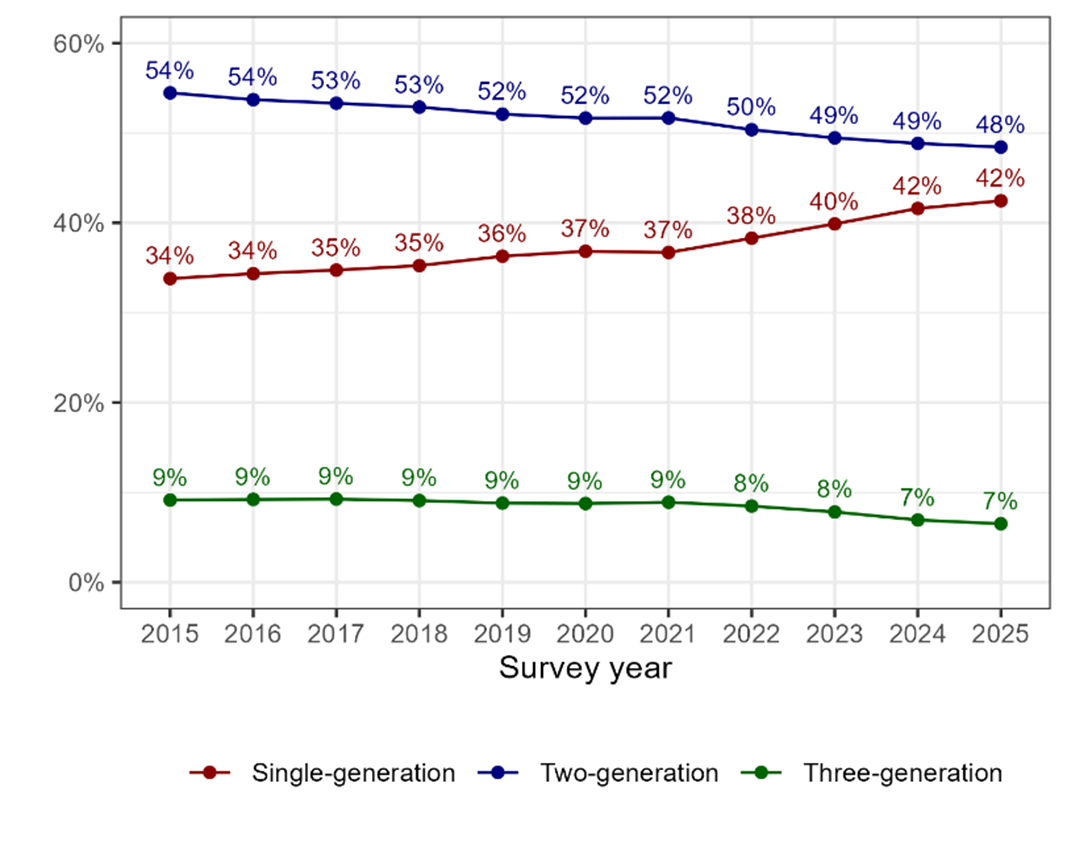
Note: The plot uses only data from the first quarter of each year and includes urban households.
Source: PNADC 2016-2025.
Statutory Retirement Age and Labor Force Participation
Using data from the 2016–2019 waves of Brazil’s Continuous National Household Sample Survey (PNADC), I estimate the labor force participation effects of retirement in Brazil for older adults. This period is selected because it captures observations that are not affected by the labor market disruptions associated with the COVID-19 pandemic or by the reform’s transition rules. Moreover, only two- or three-generation households in which older women are aged 50 to 70 and men 55 to 75 are considered. The statutory retirement ages are 60 for women and 65 for men. For these analyses, an individual is considered retired if they self-report receiving a pension from the INSS and report no paid work in the week prior to the survey.
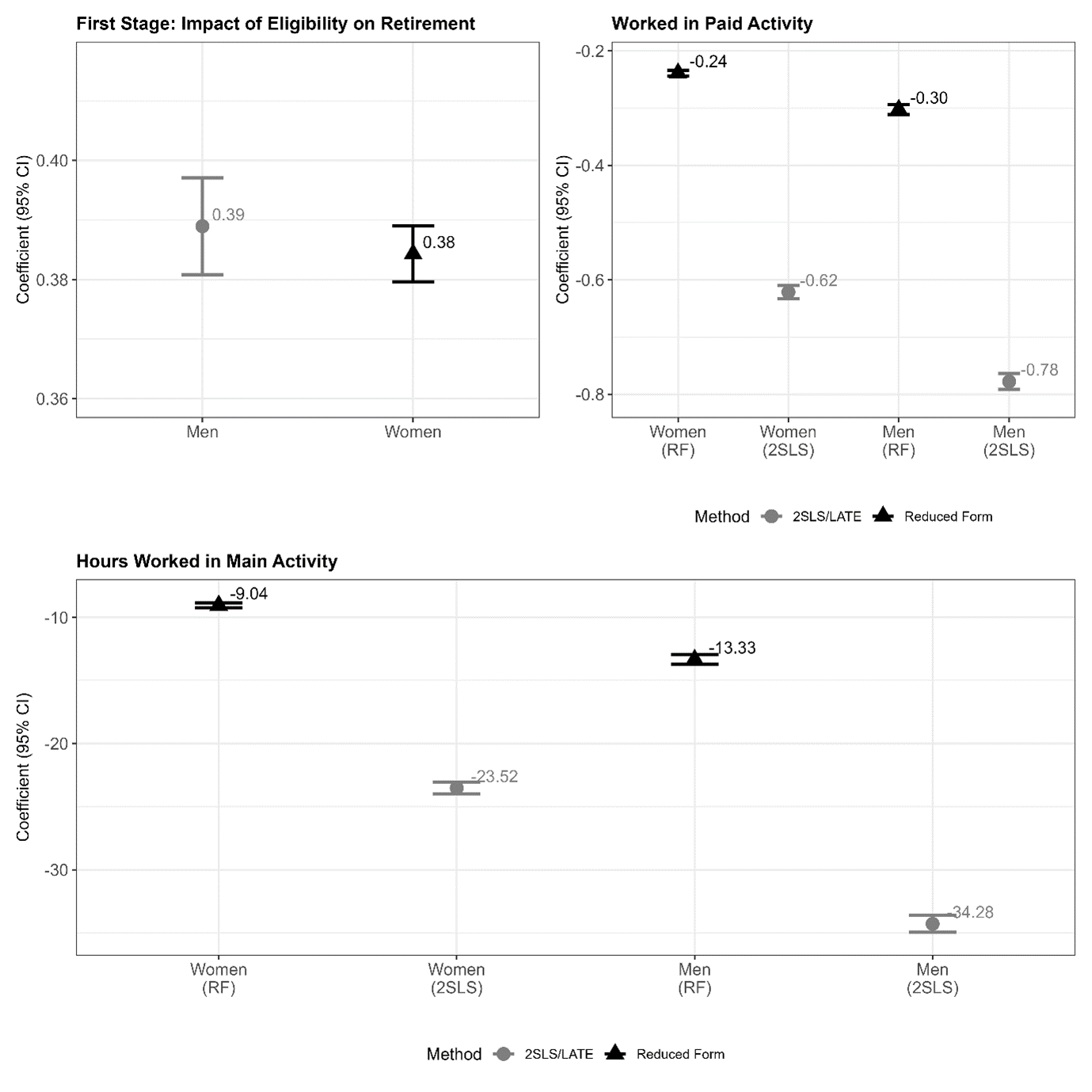
The regression analyses confirm that retirement eligibility decreases the labor force participation of older adults. These models control for education level and include region and year–trimester fixed effects. In Figure 2, being eligible for retirement increases the probability of being retired by 0.39 for men and 0.38 for women. Moreover, the share of older women working in paid employment decreases significantly in both the reduced-form and IV models (0.2 and 0.6, respectively), with the IV model using retirement eligibility as an instrument for retirement. For men, the decrease is also significant. Regarding working hours, retirement eligibility reduces women’s hours by 9.3 and men’s by 13.3. The IV models show a stronger decrease, 23.5 for women and 34.3 for men, once they transition into retirement upon becoming eligible.
Figure 2. Impact of retirement on labor force participation of older adults
Intergenerational Effects of Older Adults’ Retirement on Adult Women’s Labor
Table 1 and Table 2 show the effect of older women’s and men’s retirement on the labor force participation of adult women aged 16 to 45 who coreside with them. This analysis includes households both with and without children. According to Table 1, living with an older woman who is retirement eligible (older than 60) increases the share of adult women reporting paid work by 0.07 and raises the weekly working hours by almost 3. The 2SLS models show that coresiding with an older woman who transitions into retirement upon becoming eligible further increases these estimates. Specifically, the share of adult women reporting paid work rises by almost 0.2, while the working hours increase by an average of 7.4. These results suggest a substitution effect between older and adult women’s working hours, implying that retired older women may take on household chores or childcare, allowing younger women to increase their labor force participation.
Table 1. Impact of older women’s retirement on labor force participation of adult women
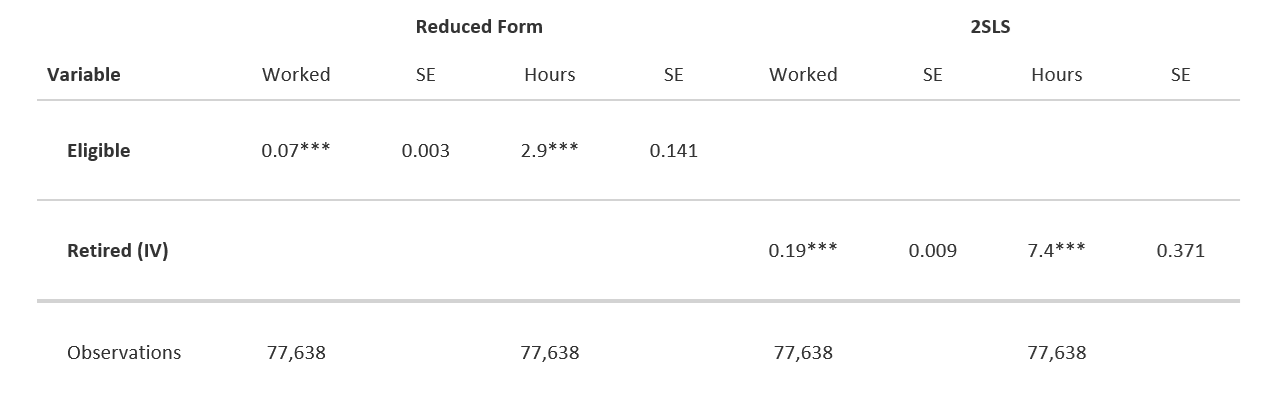
Notes: 1/. Reduced form estimates represent intent-to-treat effects of retirement eligibility for women older than the SRA, while 2SLS estimates represent the LATE effect for older women who transition into retirement once they reach the SRA. 2/. Independent variable of interest is older woman’s retirement eligibility and its interaction with household children categories. 3/. All estimations control for education level, region, and year-trimester fixed effects.
* p<0.1, ** p<0.05, *** p<0.01
Table 2 performs a similar analysis but focuses on adult women coresiding with older men aged 55 to 75. Those living with a retirement-eligible man increase their weekly working hours by 0.7 on average. Using the statutory retirement age as an instrumental variable shows that this effect is slightly larger for adult women living with an older man who retires past the retirement age, though the increase remains small, only 1.6 hours on average. These results suggest a gendered effect of older adults’ retirement: while both older women’s and men’s retirement increase adult women’s labor force participation, the effect is substantially higher for older women’s retirement. For older men’s retirement, the impact is minimal, likely reflecting a negative household income effect.
Table 2. Impact of older men’s retirement on labor force participation of adult women
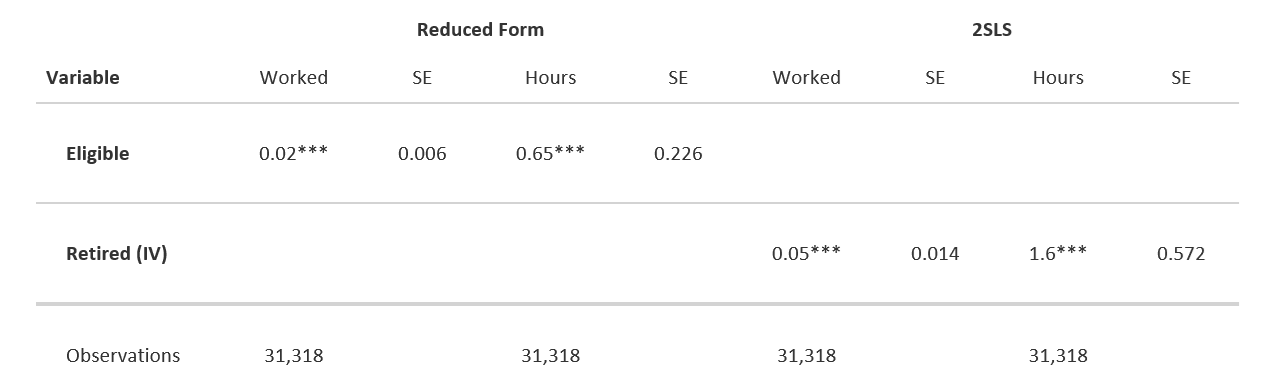
Notes: 1/. Reduced form estimates represent intent-to-treat effects of retirement eligibility for women older than the SRA, while 2SLS estimates represent the LATE effect for older women who transition into retirement once they reach the SRA. 2/. Independent variable of interest is older woman’s retirement eligibility and its interaction with household children categories. 3/. All estimations control for education level, region, and year-trimester fixed effects.
* p<0.1, ** p<0.05, *** p<0.01
Conclusion and Policy Implications
The results for Brazil indicate that older individuals’ retirement affects not only their own labor market outcomes but also the labor force participation of other household members in multigenerational households. Although the share of multigenerational households has declined over time, they still account for more than half of families in Brazil, making it crucial to understand the broader implications of life course transitions such as retirement on other household members. While it is still early to assess the labor market effects of Brazil’s 2019 pension reform, the delay in the retirement age for women and the stricter eligibility rules for men could reduce the labor force participation of younger generations, particularly adult women who rely on older household members for childcare and domestic support. These findings highlight the importance of considering intergenerational spillovers when evaluating pension policy reforms.
1 This article is an outcome of a research visit carried out in the context of the (LIS)2ER initiative which received funding from the Luxembourg Ministry of Higher Education and Research.
References
| Arza, C. (2017). El diseño de los sistemas de pensiones y la igualdad de género ¿Qué dice la experiencia europea?, Serie Asuntos de Género (No. 142). Comisión Económica para América Latina y el Caribe (CEPAL). https://repositorio.cepal.org/handle/11362/40936 |
| ECLAC. (2024). Non-contributory Pension Systems in Latin America and the Caribbean: Towards Solidarity with Sustainability. United Nations. https://doi.org/10.18356/9789210022613 |
| OECD. (2021). Pensions at a Glance 2021: OECD and G20 Indicators. OECD Publishing. https://doi.org/10.1787/ca401ebd-en |
| Presidência da República. (2019). Emenda Constitucional nº 103. |
| Queiroz, A. C. de S., and Afonso, L. E. (2025). The redistributive impacts of the Brazilian 2019 pension reform on individual pension indicators for Brazilian civil servants. International Journal of Social Welfare, 34(3), e70018. https://doi.org/10.1111/ijsw.70018 |
| Queiroz, B., and Alves, M. (2021). The evolution of labor force participation and the expected length of retirement in Brazil. The Journal of the Economics of Ageing, 18, 100304. https://doi.org/10.1016/j.jeoa.2020.100304 |
| Queiroz, B., and Bueno, M. (2011). Population aging and the rising costs of public pension in Brazil. Textos para Discussão Cedeplar-UFMG td438, Cedeplar, Universidade Federal de Minas Gerais. https://ideas.repec.org/p/cdp/texdis/td438.html |
| Queiroz, B., and Souza, L. (2017). Retirement incentives and couple’s retirement decisions in Brazil. The Journal of the Economics of Ageing, 9, 1–13. https://doi.org/10.1016/j.jeoa.2016.05.003 |
| Sarlet, I. (2021). Social Security in Brazil: Public Pension Reform and Responses to the COVID-19 Pandemic. Social Law Reports, Issue 6, 2021, Max Planck Institute for Social Law; Social Policy. |
| Zviniene, A., and Tsukada, R. (2023). The Brazilian Pension System Under an Equity Lens. Washington, D.C.: World Bank Group. |