
Issue, No.38 (June 2026)
A Slow Convergence? Intra-couple Division of Labour and Related Perceptions in South Korea, 2004–2024
Key messages
- While the patterns of unpaid and paid work division among South Korean couples have changed significantly over time – shown in a sharp decline in the share of male-breadwinner couples – egalitarian arrangements remain rare.
- The dominance of female-overperformance couples and a simultaneous rise in male-overperformance couples are partly explained by stubbornly long paid work hours especially among men.
- Egalitarian arrangements correlate with women’s higher housework satisfaction but not their life satisfaction under Korea’s restrictive norms and limited institutional support.
Introduction
South Korea presents a prototype of the East Asian developmental, familialistic welfare state, where gender equality has not caught up with its rapid economic development and rising female educational attainment. Among advanced economies, the country consistently ranks among the most gender-unequal advanced economies both in the sphere of paid and unpaid work. While young women’s employment rate has increased steadily over the past two decades, men’s share of household and care work remains among the lowest in the world (Charmes, 2019). This imbalance of unpaid and paid work within couples is increasingly recognized as one of the key drivers of historically low marriage and fertility rates in Korea (Raymo et al., 2015; Yoon, 2016).
From a macro-social perspective, scholars have considered the intra-couple allocation of unpaid and paid work as a core indicator capturing societal progress of ‘gender revolution’ across post-industrial economies (Esping-Andersen and Billari, 2015; Goldscheider et al., 2015). In societies where this revolution stalls, rising female labour force participation is not matched by men’s increased burden-sharing in unpaid work. Women would then respond by postponing or forgoing family formation as they perceive the situation as ‘inequitable’ (McDonald, 2013). Yet the extent to which couples perceive unequal arrangements as unfair or inequitable, and the extent to which a more equal division translates into greater well-being, depends not only on objective shares of work, but also on individual preferences, absolute hours spent on paid work and prevailing social norms. For instance, in certain contexts, unequal divisions of housework are perceived by women as fair when combined with part-time arrangements (Koster et al., 2022).
In this study, we document the evolution of the household division of labour among Korean couples aged from 25 to 49 years from 2004 to 2024, using five waves of the Korean Time Use Survey (n = 12,447 dyadic observations). We classify couples into six types based on their relative shares of time spent on paid and unpaid work, and examine how these typical patterns are associated with two subjective measures: satisfaction with housework allocation and general life satisfaction.
How are Korean couples dividing paid and unpaid work?
To move beyond simple averages, we classify couples’ time-use patterns into six mutually exclusive groups based on men’s share of unpaid and paid work within couples. Drawing on a multiple-equilibria framework proposed by Esping-Andersen et al. (2013), we first identify couples within a symmetric band – where neither partner bears a disproportionate combined burden of paid and unpaid work. Note that these symmetric burden-sharing patterns are not always perceived as fair or equitable by individuals. Therefore, these couples are further classified as traditional, adaptive, egalitarian, or subversive based on how they divide unpaid work specifically. Couples outside this symmetric band are labelled as female overperformance (when women are overburdened in the combined share) or male overperformance (when men are overburdened). Figure 1 illustrates this typology.
Figure 1. Classification of intra-couple allocation of paid and unpaid work hours
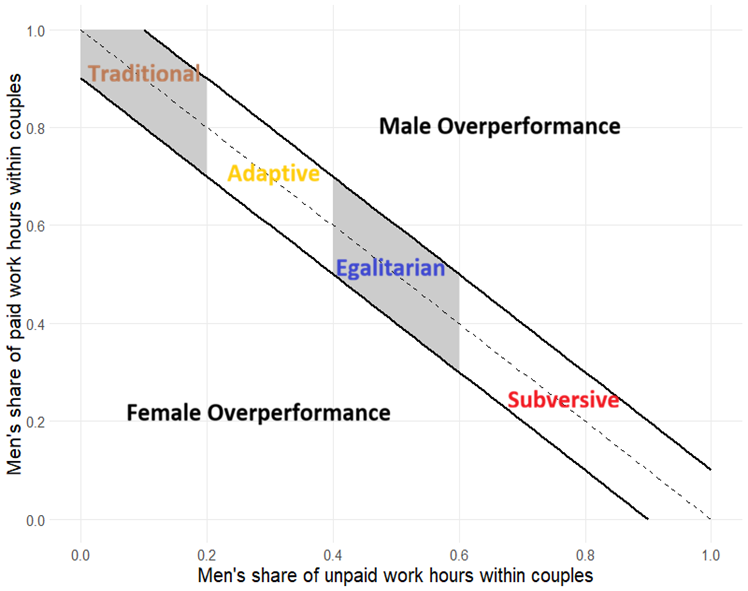
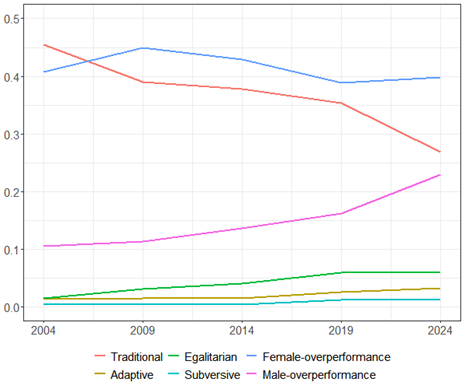
Figure 2 illustrates changes in the distribution of couples’ allocation types over the past two decades. Throughout the period, the female-overperformance group – where women bear dual responsibilities in work and family – has constituted the largest share among Korean couples, stably at around 39 to 44 percent. On the other hand, the traditional type, representing the male-breadwinner arrangement, has substantially declined from nearly 46 percent of all couples in 2004 to around 27 percent in 2024. However, this decline has not given way to a rise in egalitarian households: these account for only around 6 percent of couples and have plateaued since 2019. Instead, the fastest-growing group is the male-overperformance type, rising sharply in the past five years to nearly 23 percent. This shift is partly explained by a slow convergence of women’s and men’s time spent on unpaid work but more so by men’s stubbornly long paid work hours. The share of adaptive couples has also grown but only marginally, from 1 percent to 3 percent over the last two decades.
Figure 2. Changes in the share of allocation types in Korea, 2004–2024 (weighted)
Source: own calculations based on Korean Time Use Survey.
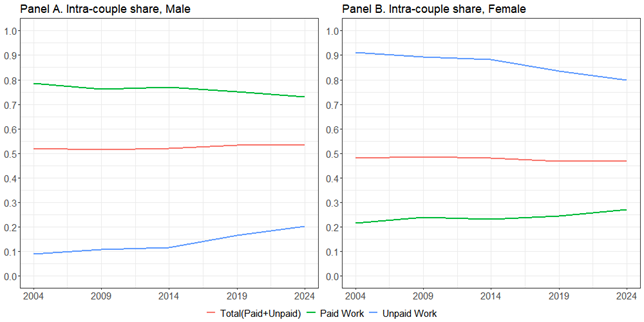
Figure 3 displays the relative share of paid work, unpaid work and combined working time within couples, partly revealing the mechanism behind these trends. Rather than a significant reallocation of the intra-couple time use, what is happening is a slow and partial convergence at best. Men’s share of unpaid work within couples has roughly doubled, from around 9 to 20 percent, while their share of paid work has declined modestly, from about 79 to 73 percent. Women’s shares have changed symmetrically as the indicators capture the intra-couple share – unpaid work time from around 91 to 80 percent and paid work time from around 22 to 27 percent. Meanwhile, the total time spent on both unpaid and paid work has remained largely flat: men at around 52 percent and women at 48 percent. One might find this pattern counterintuitive, since the female-overperformance group has been the dominant type throughout the period but at the same time men’s total time share has been above 50 percent. This is largely explained by men’s excessive hours spent on paid work in absolute terms.
Figure 3. Changes in couples’ intra-couple share of paid and unpaid work, 2004–2024 (weighted)
Source: own calculations based on Korean Time Use Survey.
How does the division translate into subjective perceptions?
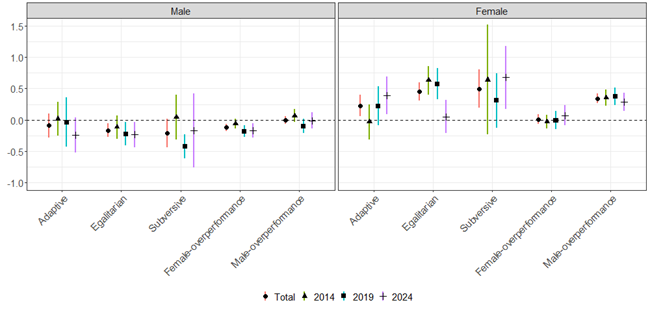
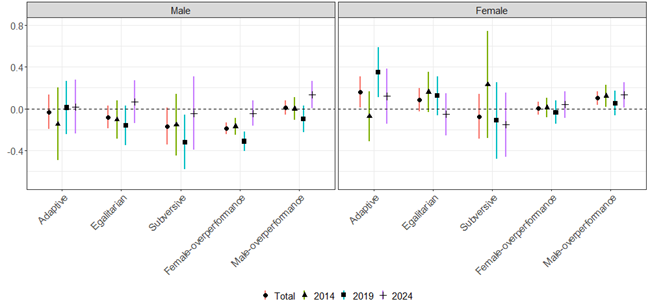
Does the type of intra-couple time allocation matter for subjective perceptions and well-being? In Figures 4 and 5, we present results from regression analyses of how these allocation types are associated with two subjective outcomes – allocation satisfaction and life satisfaction – controlling for education, age, household income, care needs (mostly for children), number of children, gender attitudes, bad health, overwork status and region of residence. The coefficients represent the marginal difference in the two outcomes between the type of interest and the traditional type – the reference group. As these outcome variables are available from 2014, we compare the effects based on the full sample since then and year-by-year estimates to detect changes in perceptions over time.
Figure 4. Marginal effects of allocation types on allocation satisfaction, 2014–2024 (ref. Traditional)
Source: own calculations based on Korean Time Use Survey.
Regarding allocation satisfaction — how satisfied individuals are with how housework is divided — the results differ by gender (Figure 4). Among men, those in egalitarian arrangements tend to report modestly negative satisfaction, in contrast to the expectation that equality benefits both partners equally. Being in a female-overperformance arrangement is associated with significantly lower allocation satisfaction. Among women, those in adaptive, egalitarian, subversive, and male-overperforming arrangements report higher allocation satisfaction than those in traditional arrangements.
The picture changes substantially when we turn to life satisfaction (Figure 5). Among men, only a female-overperformance arrangement, which also showed lower allocation satisfaction, is associated with significantly lower life satisfaction. Among women, there also appears to be a gap between allocation and life satisfaction. Women in egalitarian and subversive arrangements report higher satisfaction with their housework division but not higher life satisfaction. By contrast, women in adaptive and male-overperforming arrangements report higher levels of both allocation and life satisfaction. Notably, women in adaptive arrangements showed the highest life satisfaction overall. This ‘adaptive advantage’, despite not yielding the highest perceived fairness, suggests that societal norms and limited institutional support hinder the full benefits of equality.
Figure 5. Marginal effects of allocation types on life satisfaction, 2014–2024 (ref. Traditional)
Source: own calculations based on Korean Time Use Survey.
Concluding remarks
Two decades of change in Korean households tell a story of partial and uneven transformation. The traditional male-breadwinner model is clearly waning, but egalitarian arrangements have not filled the gap. The rapidly growing male-overperformance pattern, driven by men’s persistently long paid working hours rather than a genuine redistribution of care, suggests that Korea’s gender revolution remains incomplete. Female-overperformance, the most burdensome arrangement for women, has proven durable at around 40 percent of couples.
These findings yield several key policy implications. First, enforcing strict working-time limits may be just as vital for domestic equality as expanding childcare and promoting parental leave uptake. Second, the muted life satisfaction gains from egalitarian arrangements among women may reflect normative and institutional constraints. Therefore, structural reforms must be paired with cultural change to fully realize the well-being benefits of greater equality. Third, the rise of male-overperformance creates a new dimension of precarity, and policies focusing solely on women’s labour force participation risk overlooking this issue.
References
| Charmes, J. (2019). The Unpaid Care Work and the Labour Market. Geneva: International Labour Organization. |
| Esping-Andersen, G., & Billari, F. C. (2015). Re-theorizing family demographics. Population and Development Review, 41(1), 1–31. |
| Esping-Andersen, G., Boertien, D., Bonke, J., et al. (2013). Couple specialization in multiple equilibria. European Sociological Review, 29(6), 1280–1294. |
| Goldscheider, F., Bernhardt, E., & Lappegård, T. (2015). The gender revolution: A framework for understanding changing family and demographic behavior. Population and Development Review, 41(2), 207–239. |
| McDonald, P. (2013). Societal foundations for explaining low fertility: Gender equity. Demographic Research, 28, 981–994. |
| Raymo, J. M., Park, H., Xie, Y., et al. (2015). Marriage and family in East Asia: Continuity and change. Annual Review of Sociology, 41, 471–492. |
| Yoon, S. Y. (2016). Is gender inequality a barrier to realizing fertility intentions? Asian Population Studies, 12(2), 203–219. |